
The End of the Expert Bottleneck
Article 2 of 6 in The AI Transformation Playbook
Why your best employee can finally be everywhere at once
Every organization has them. The person everyone asks. The one who somehow knows where everything is, how everything works, and what happened the last time someone tried that brilliant idea.
They're invaluable. They're also a massive operational risk.
Because here's the thing about human expertise: it doesn't scale. Your best advisor can only talk to one client at a time. Your senior claims specialist eventually needs to sleep. Your veteran employee who knows things nobody wrote down will, at some point, retire. And when they do, all those people who were asking them questions will be asking someone else. Someone who doesn't know.
The expert bottleneck isn't just an inconvenience. It's a structural constraint on what your organization can accomplish. It creates dependency on individuals, inconsistency in customer experience, anxiety among newer employees, and fragility in operations.
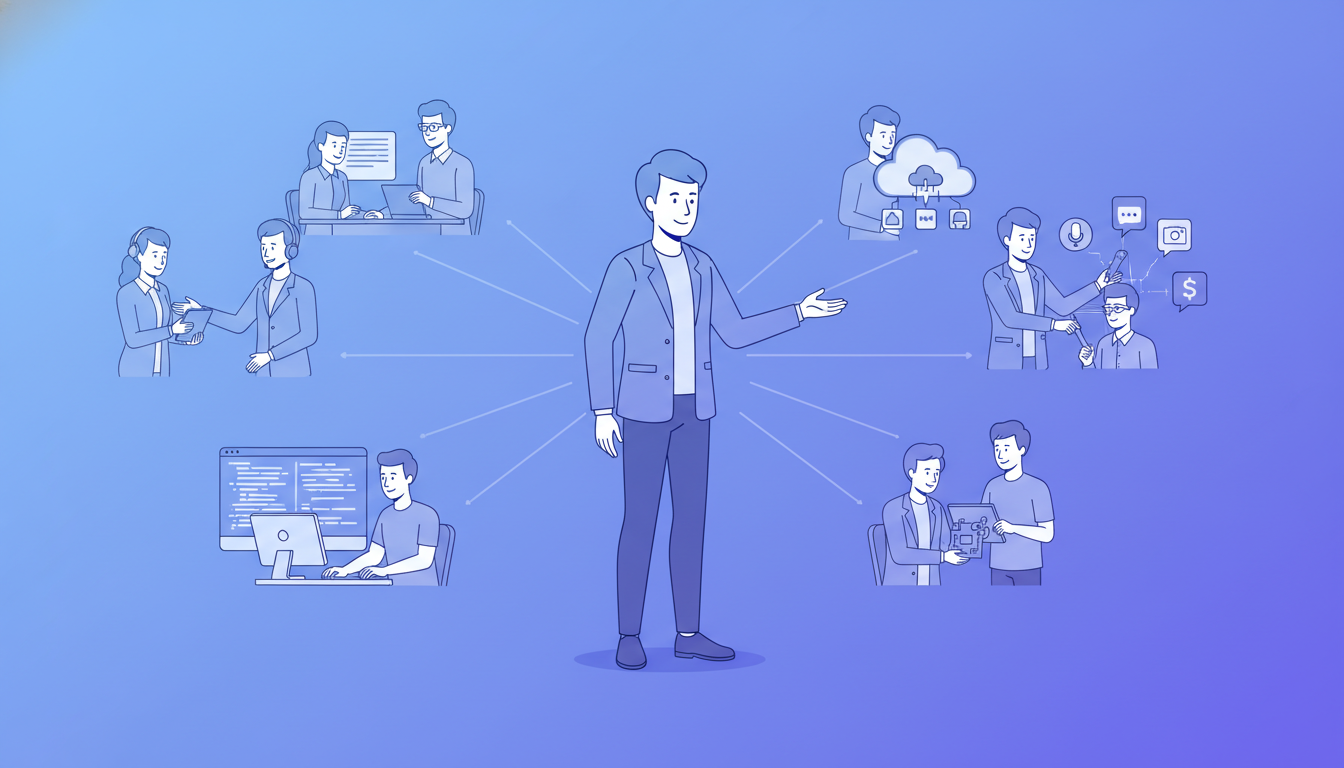
AI doesn't replace these experts. It multiplies them.
The Commercial Real Estate Brokerage Reality
Consider a commercial real estate brokerage scenario. Not hypothetical, but representative of patterns we've observed across dozens of client-facing organizations.
A business owner calls about relocating their manufacturing operation. They need more space, different zoning, maybe proximity to rail or interstate access. They want to know what's available in their target markets, what the lease versus own economics look like, and whether the timing makes sense given market conditions.
The veteran broker handles this effortlessly. They've answered some variation of this question hundreds of times. They know which submarkets have the infrastructure their client needs, which landlords are flexible on build-out, which properties have hidden issues that don't show up in listings. They can spot the opportunities that business owners don't know to ask about.
The broker who started three months ago? Different story. They can search listings. They can look things up. But they lack the intuitive market framing that comes from years of client conversations. The client senses this hesitation. The interaction takes longer and produces less confidence. Maybe the client proceeds anyway. Maybe they say they need to "think about it" and end up calling a competitor where someone made them feel more certain.
This gap between veteran knowledge and new employee capability exists in virtually every client-facing role. And traditionally, the only solution was time. Let people accumulate experience. Accept that newer employees will underperform until they develop expertise. Hope the veterans stick around long enough to build institutional depth.
AI breaks this constraint.
Knowledge at the Point of Need
Modern AI systems can serve as expert companions for client-facing employees. Not scripts to read from, not FAQ databases to search through, but genuine problem-solving tools that respond to the actual situation at hand.
The commercial real estate broker with three months of experience can now query an AI system with the client's actual situation: "Manufacturing client needs 40,000 square feet, heavy power requirements, dock-high loading, within 20 miles of the airport, budget up to $12 per square foot NNN." The system responds with a complete analysis: available properties matching criteria, comparable lease rates by submarket, landlord reputation notes from previous deals, zoning considerations for manufacturing use.
The broker isn't reading a script. They're getting expert-level guidance that they can translate into natural client conversation. They know what to recommend and why. They can answer follow-up questions by querying for more detail. They have the confidence that comes from having a knowledgeable colleague available at all times.
This isn't theoretical. Organizations deploying these systems report that employee confidence increases dramatically when knowledge gaps no longer create client interaction anxiety. The psychological shift matters as much as the practical capability. Employees who previously dreaded questions outside their immediate expertise now approach them with curiosity rather than fear.
And the client experience? It becomes consistent. The new hire and the twenty-year veteran can both provide comprehensive guidance because both have access to the same expert knowledge system. The variance that previously came from who happened to answer the phone starts to flatten.
Beyond Real Estate: Technical Expertise at Scale
The expert bottleneck shows up everywhere expertise exists, but it's particularly acute in technical roles where specialized knowledge determines whether problems get solved.
Consider field service operations for commercial building systems. A technician arrives at a client site facing HVAC failure in a data center. The symptoms are ambiguous. The system throws three fault codes simultaneously: E47, F12, and a refrigerant pressure warning. That combination doesn't appear in any troubleshooting guide because it usually indicates multiple cascading failures. The experienced technician has a mental model built from hundreds of similar situations. They know which symptoms point where, which tests to run first, which failure modes are common for this equipment age and configuration.
The newer technician has training and documentation. But documentation describes ideal cases. Real problems are messy. The fault code combination doesn't match the troubleshooting guide. The temperature readings appear in a pattern that suggests chiller problems but the refrigerant warning points elsewhere. The facility manager adds information about recent changes that complicate the picture.
Traditionally, the newer technician calls the senior tech. Maybe they get through, maybe they leave a message. Maybe the senior tech is already helping someone else. The client waits. The bottleneck constrains how many issues the organization can resolve simultaneously.
AI diagnostic systems change this dynamic. The field technician describes the symptoms (including photos, error codes, operational data) and receives diagnostic hypotheses ranked by probability based on the specific symptom pattern. The system draws on documented failure modes, historical repair data, and environmental factors to suggest investigation sequences.
The newer technician isn't operating blind anymore. They have a starting point that incorporates organizational learning from every similar problem anyone has encountered. They can work through the diagnostic sequence, refine the hypothesis as they gather more information, and escalate to human experts only when the situation genuinely requires it.
This doesn't replace expertise. The senior technicians are still essential for novel problems, complex situations, and capability development. But it does expand how much expertise is available at any given moment. The organizational capacity for technical problem-solving increases without proportional senior headcount growth.
The Procurement Coordination Example
The expert bottleneck isn't limited to client-facing or technical service roles. It appears wherever specialized judgment determines outcomes.
Procurement teams face constant complexity. Vendor selection, contract negotiation, compliance verification, supplier performance tracking. A purchase request comes through that looks straightforward, but it triggers questions: Is this vendor approved? Do we have existing agreements that cover this category? What were the results last time we used this supplier? Are there compliance requirements that apply to this purchase type?
If answers wait for the one person who really understands the vendor management system or remembers the history with problematic suppliers, requests get delayed. If the generalist procurement coordinator guesses wrong, mistakes create compliance issues or cost overruns.
AI systems trained on vendor databases, contract repositories, and historical performance data can provide guidance at the point of need. The procurement coordinator enters the request details. The system correlates with existing agreements, flags compliance requirements, surfaces performance history, and suggests alternatives if issues exist.
This doesn't replace the procurement specialist. It accelerates the triage process. High-confidence situations with established vendors and clear policies can proceed immediately. Ambiguous situations get flagged for specialist review with documented context that makes the consultation more efficient when it happens.
The bottleneck loosens. More requests get processed promptly. Specialist time focuses on strategic sourcing and complex negotiations rather than answering routine queries.
The Self-Service Revolution
Taking this one step further: what happens when clients or employees can access expert knowledge directly?
Not FAQ pages or keyword search through documentation. Genuine problem-solving interfaces where people describe what they're trying to accomplish and receive comprehensive guidance.
A facilities manager at a company considering office relocation wants to understand space requirements. They don't know what questions to ask because they don't know what they don't know. Traditional approaches expect them to search for "office space calculator" or call and wait for a callback when they might not even know the right terms to use.
An AI interface accepts "we have 150 employees, mix of desk workers and people who travel frequently, we want collaborative spaces and quiet areas" and responds with structured guidance: square footage ranges for different layouts, considerations for hybrid work patterns, typical build-out requirements, questions they should be asking potential landlords. The facilities manager gets a framework for the conversation they need to have with a broker.
This extends the expert multiplication even beyond the organization's workforce. Clients begin their journey better informed because the expertise is embedded in the interface rather than requiring human delivery.
Organizations we've worked with that handle this well report handling three to five times the inquiry volume per staff member based on early implementations. The ratio of inquiries handled to employees available changes fundamentally.
The New Employee Experience
Here's an angle that doesn't get discussed enough: what extending expertise across the organization does for culture and employee retention.
Being new somewhere is hard. You don't know where things are, how things work, or what happened before you arrived. Every question reveals your inexperience. Every gap in knowledge risks making you look incompetent. The anxiety is real, and it affects performance.
Organizations with robust AI knowledge systems change this experience. New employees have immediate access to institutional expertise. They can query rather than guess. They can learn in context rather than front-loading everything in orientation. They can approach unfamiliar situations with confidence rather than dread.
This matters for retention. People leave jobs where they feel incompetent or unsupported. They stay in jobs where they feel capable and valued. Making expertise accessible reduces the psychological burden of being new, which reduces early attrition, which reduces the cost and disruption of constant hiring cycles.
It also changes the role of veteran employees. Rather than spending time answering the same questions repeatedly (which gets old), they can focus on genuine knowledge development and complex problem-solving. Their expertise still matters. It just matters for different things.
Implementation Considerations
Scaling expertise across the organization isn't a technology purchase. It's an organizational change that requires technology.
The systems themselves work. AI can absolutely serve as an expert companion for diverse roles. But making it work in practice involves more than deployment.
Knowledge base development matters. The AI is only as useful as the expertise it can access. Organizations need to deliberately capture and structure the knowledge they want to extend. This means policy information, underwriting frameworks, diagnostic patterns, client scenarios, and the contextual wisdom that makes expertise valuable. Garbage in, garbage out applies.
Query training makes a difference. Employees need to learn how to ask effective questions. This isn't complicated, but it isn't automatic either. Someone who searches Google keyword-style will get worse results than someone who describes a situation naturally. A little training goes a long way.
Workflow integration determines adoption. Tools that require employees to switch contexts, log into separate systems, or interrupt their flow see less use than tools that meet them where they already work. The best AI expert systems feel like having a knowledgeable colleague nearby, not like operating a separate application.
Trust develops over time. Employees who've been burned by unhelpful technology (which is most employees) approach new tools skeptically. Initial positive experiences build confidence. Negative early experiences create resistance that's hard to overcome. Paying attention to first impressions matters.
Continuous improvement is essential. Knowledge gaps surface through usage. Questions the system can't answer well reveal areas needing development. Organizations that treat deployment as a starting point rather than an endpoint build systems that get better over time.
The Multiplication Effect
Let me be direct about what's at stake here.
The organizations that figure this out don't just solve the expert bottleneck. They fundamentally change their scaling economics.
Previously, expanding service capacity required proportional expertise expansion. More clients meant more experienced staff. More technical complexity meant more senior headcount. Geographic expansion meant replicating expertise in each location.
With expertise multiplication, specialized knowledge becomes a fixed cost rather than a variable one. Capture it once, deploy it everywhere. New hires access it immediately. New locations inherit it automatically. Capacity expands without proportional expertise overhead.
This is why breaking the expert bottleneck matters strategically, not just operationally. Organizations that accomplish this can grow in ways constrained competitors cannot match.
Your best employee can finally be everywhere at once. The question is whether you'll build the systems that make it possible.
Next in the series: "Reclaiming the 40%" examines how AI eliminates documentation overhead and returns professionals to the work they were actually hired to do.